
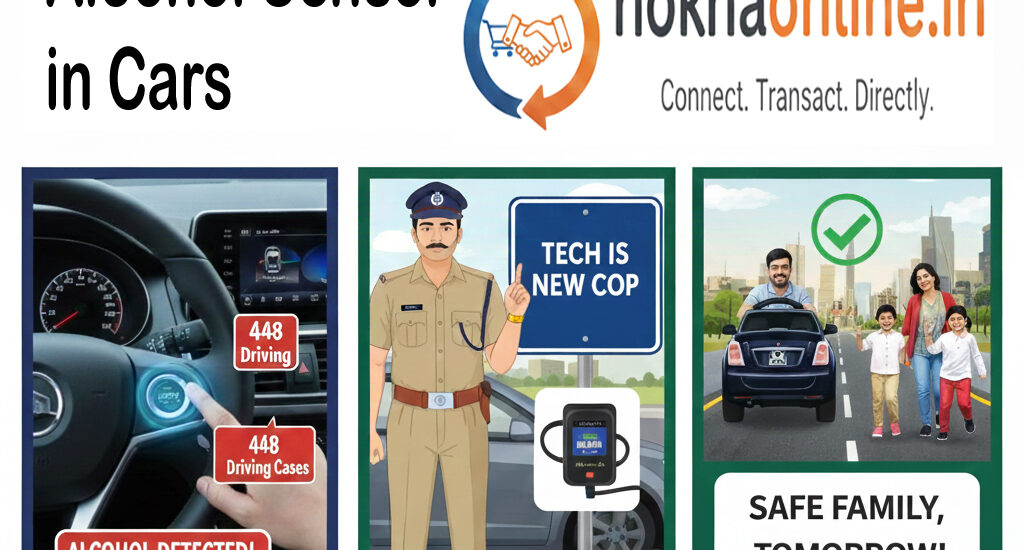
Technology’s surgical strike against drunk driving:
Preface : When discipline fails, let the machine take charge
This Article points to a bitter truth.The massive increase in drunk driving cases in various cities across the country during the New Year celebrations shows that mere paper laws and police blockades are not enough.
When humans fail to understand their responsibility, technology has to step in. This article isn’t just about cars, but about the intersection of human behavior and technology that could save thousands of lives.
1. India's road safety crisis: A mirror of statistics
India has one of the world’s highest road accident fatalities. According to 2025 data, approximately 150,000 people die in India each year. Between 15% and 20% of these accidents are directly linked to drunk driving.
01. Example of Delhi, Mumbai, Jaipur, Pune: In the beginning of 2026, the police of various cities found that despite heavy fines, people did not stop driving under the influence.
02. Challenge of Metro Cities: Alcohol has been found to be a major factor in 60% of fatal accidents occurring between 11 pm and 4 am in cities like Delhi, Mumbai and Bengaluru.
03. Economic loss: Road accidents cause loss of about 3% of India’s GDP.
Hyderabad (recorded the highest number of cases) | 2,731 | Most cases were registered here. Police conducted checks at 120 locations. |
| Delhi | 868 | Police deployed 20,000 personnel and kept a close watch on areas like Connaught Place. |
| Mumbai | 211 | saw a 37% decrease compared to the previous year (333 cases), attributed to the year-long crackdown by the police.
|
| Jaipur | 219 | also saw a significant jump; the number was just 12 in 2024. |
| Bengaluru | — | The police here took a unique initiative – providing a drop-off facility to those who were heavily drunk to safely drop them home. |
2. Why is technology the ultimate solution?
From a management perspective, any problem is solved at three levels:
1. Awareness: This has been ongoing for years, but results are slow.
2. Enforcement: Police checking, which is not possible on every road.
3. Prevention: Creating a system that eliminates any room for error.
“If the car itself decides not to be driven by a drunk driver, there’s no question of an accident.” This is known in management as ‘Poka-Yoke,’ meaning a design that makes mistakes impossible.
3. DADSS technology: The safety shield of future cars
The technology that’s getting the most attention around the world is the Driver Alcohol Detection System for Safety (DADSS). It works in two main ways:
A. Breath-Based Sensors (Passive Alcohol Sensors)
Older breathalyzers required you to blow forcefully into a tube. But newer cars have smart sensors built into the dashboard.
· Working: This sensor uses infrared light to scan for carbon dioxide and alcohol molecules present in the cabin air.
Accuracy: It detects whether a driver has consumed alcohol just from their normal breath. This technology is so smart that it can differentiate between driver and passenger breath.
B. Touch-based Sensors
This technique is for those who try to trick the sensor by opening a window or wearing a mask.
Working: An Infrared Spectrometer is fitted on the car’s ‘Start/Stop’ button or gear lever.
The process: As soon as you press the button, a special light scans the capillaries beneath your skin and measures your blood alcohol level. If the level is above 0.03% (Indian standard), the engine won’t start.
4. Volvo and the magic of eye-tracking technology
Swedish company Volvo has always been a leader in safety. They have taken a different approach to detecting drunk driving.
· Driver Monitoring Cameras: High-definition cameras mounted near the steering wheel monitor the movement of the driver’s pupils.·
Behavior analysis: If the driver is blinking frequently, distracted from the road, or swaying, the AI understands that the driver is either drunk or sleepy.
Action: In such a situation, the car brings itself to a safe speed, gives a warning and if necessary, stops the car on the side of the road.
5. Rejuvenating Old Cars: Alcohol Interlock Device
There are millions of old cars in India. The solution for them is the Alcohol Interlock Device.
· Installation: This device is mounted on the dashboard of the car and is connected to the car’s wiring (starter circuit).·
Mandatory: In many countries, drivers whose license has been revoked for drunk driving can get their license again only if they install this device in their car.
Uses in India: Currently this device is proving to be a boon for school buses and heavy trucks.
6. The 'False Positive' Challenge: Will perfume stop a car?
The biggest argument of the critics is that if someone uses mouthwash or there is a smell of sanitizer in the car, will the car get locked?
Solution: Modern sensors detect alcohol isotopes. These sensors are being developed to distinguish between drinking alcohol (ethanol) and sanitizer (isopropyl/methanol).
Secondary Checking: If the system suspects something, it gives the driver the option to take the test again after 5 minutes.
Legal changes, role of Indian startups, maintenance guide and future challenges (2026-2030)
7. Legal framework in India and the new regulations for 2026
In India, drunk driving is a punishable offense under Section 185 of the Motor Vehicles Act. However, the law is changing by 2026:
Pressure for mandatory technology: The Ministry of Road Transport (MoRTH) is now considering making ‘alcolock’ mandatory in commercial vehicles (such as school buses and trucks).
Digital Challans: New technology will send data directly to a cloud server if a vehicle is stopped due to intoxication. This will help police identify “hotspots” where drunk driving attempts are most common.
Court’s stance: In many cases, instead of sending criminals to jail, the court is now ordering them to install ‘alcohol interlock’ in their vehicles, which is safer for the society.
8. Indian Startups and the 'Make in India' Impact
Indian engineering students and startups are revolutionizing this sector:
· Smart Helmet: Two-wheelers are the most common vehicle in India. Startups like SafeRide have developed helmets that connect to the bike via Bluetooth. If the rider has consumed alcohol, the bike’s ignition won’t turn on.·
Affordable sensor solutions: Indian startups are developing ‘add-on’ kits for between ₹10,000 and ₹15,000 that can be installed on any old Maruti or Hyundai car.
9. Role of Insurance Companies: Economic Benefits
In the future, your car’s technology will determine your insurance premium.
· Safe Driver Rewards: Insurance companies may offer a 15-20% discount on premiums if your car is fitted with anti-drunk driving sensors.·
Claim Rejection: As per the new rules of 2026, if an accident occurs by bypassing the sensor equipped vehicle, the insurance company will not pay even a single rupee as claim.
10. Guide to Maintenance and Device Longevity (Check-list)
01. Sensor Calibration: Have the sensor calibrated every 5,000 kilometers or 6 months.
02. Software Updates: Since these are AI-based systems, keep installing patches/updates released by the companies.
03. Backup ignition: Make sure your device has an ’emergency override’ feature that can only be opened with a special code from the police or company.